
I spent the recent Pongal holidays doing exactly what I am most passionate about: reclaiming time for deep reading. It was during this quiet window of reflection that I bumped into a piece of news so transformative that it demanded more than just a bookmark; it demanded a dissection of what it means to lead in an age of man-made crisis.
Every global executive carries a silent ledger of “unsolvable” liabilities. In the corporate world, we call them legacy systems or stranded assets. In the civic world, they are called landfills; monuments to a linear economy that promised us there was such a place as “away.”
“The impediment to action advances action. What stands in the way becomes the way.” ~Marcus Aurelius
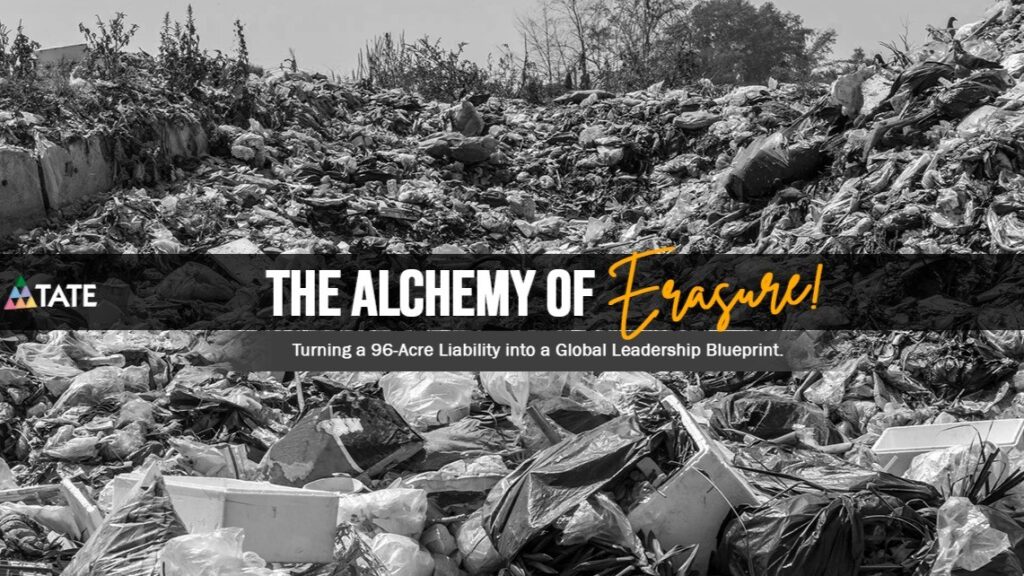
For decades, the Perungudi dumpyard in Chennai continued to be a 96-acre admission of defeat. A mountain of waste so vast it became a landmark of despair, a toxic inheritance for a city of millions. Most leaders would have looked at that mountain and negotiated a truce; possibly, a taller fence, a thicker layer of dirt, a more sophisticated way to look the other way.
But Chennai decided to stop negotiating with its own failure. In a feat of industrial defiance that will resonate with the ministries of Asian countries, the city has successfully excavated and erased 1.7 million cubic metres of legacy waste (Source: The Better India). They simply dismantled the problem.
From Stranded Liability to Circular Asset
Innovation is often misdiagnosed as a new gadget. In reality, true innovation is the courage to apply a process until the problem disappears. At the heart of this transformation is biomining, a process led by Blue Planet Environmental Solutions.
This was a high-stakes industrial operation. We are talking about 9,000 tonnes of waste processed every single day, with each batch undergoing 52 rigorous safety checks to ensure that the reclamation of land did not come at the cost of the environment.
As the head of a boutique leadership consulting firm, my team and I are constantly on the lookout for rare individuals who can manage “messy” scales. The Perungudi project is a masterclass in that specific brand of excellence. It requires a unique psychological profile: the ability to see a mountain of filth and visualize a supply chain of value.
The results are staggering. Per the report, the “ghosts” of Chennai’s past consumption have been literally reincarnated:
- Steel once buried in the muck is now hardware and utensils.
- 3,000 tonnes of glass have been reborn as bottles.
- Stones have been crushed into concrete slabs.
- Plastics, the perennial villain of the modern age, have been transformed into outdoor furniture, ramps, and pallets.
Most importantly, these plastic products can be recycled seven to eight times. This isn’t just waste management; it is the forced birth of a circular economy in a place where hope had previously gone to die.
The Human Architecture of (almost) a Miracle
We often credit technology for these wins, but technology is just a tool. The real engine of the Perungudi cleanup was a coalition of human will. To achieve this, you need a specific ecosystem of talent:
- The Visionary Bureaucrat: The leader who stakes their reputation on a project that won’t be finished during their current term.
- The Operational Stoic: The engineers who can maintain 52 safety checks a day while staring down 9,000 tonnes of garbage.
- The Strategic Partner: Organizations like Blue Planet, who, as the article notes, have already reclaimed 700 acres of land across India, proving that sustainability is a muscle that grows stronger with every “impossible” task completed.
This is the leadership blueprint for the 21st century. It is the shift from managing a crisis to solving it. It is the transition from being a custodian of a problem to being an architect of its exit.
A Warning and a Promise to the C-Suite
If you are a senior executive reading this, do not mistake this for a “local interest” story from South India, or a promotion for a specific political party in disguise. This is a mirror!
The world generates 62 million tonnes of waste annually. Our global supply chains are currently built on the assumption that we can keep externalizing our costs into the ground. Chennai has just proven that the ground is full – and that the only way forward is to mine our own mistakes for the resources of the future.
The city is now moving its sights to Kodungaiyur, a site three times the size of Perungudi. They are not going to stop because they have realized that the “unsolvable” was actually just a lack of industrial imagination.
The Executive Takeaway
The next time you sit in a strategy session and someone says a legacy problem is “too big to touch” or “part of the landscape,” think of the 20 football fields of trash that vanished from Chennai.
The leaders of tomorrow will not be judged by the growth they managed, but by the liabilities they had the courage to erase. Chennai just provided a global masterclass in how to stop being a victim of your own history. Don’t just manage the mountain. Mine it!
Disclaimer
Credits: This article is based on the original news report carried by The Better India .
Notice: The analysis and opinions expressed herein are solely those of the author and do not represent the views of the original publisher. This content is provided for informational purposes “as is” without warranties. The author assumes no liability for any errors in the source material or for any damages resulting from the use of this commentary.